
Private companies already play important roles across the warning-to-action chain, from risk data and analytics to telecommunications, financing and service delivery. As a result, many early warning systems now operate as multi-actor ecosystems.
As private sector actors become increasingly embedded in early warning systems, a key question emerges: how can partnerships strengthen outcomes for people at risk while safeguarding equity, accountability and long-term sustainability? This new report in collaboration with and funded by the Zurich Climate Resilience Alliance, Private Sector Engagement in Early Warning Systems: Governing Tradeoffs in Evolving Multi-Actor Systems, and its policy brief, explore exactly that challenge.
Moving beyond “the private sector”
Discussions about private sector engagement often remain broad and treat the private sector as a single actor. Early warning systems involve a diverse range of companies, from technology providers and telecommunications firms to risk analytics companies, financial institutions, and service providers.
Each brings different capabilities, incentives, and potential risks. A company disseminating warnings through mobile networks, for example, plays a very different role from a firm developing hazard analytics or a financial institution supporting anticipatory action.
The report argues that understanding these differences is essential for designing effective partnerships and ensuring private sector engagement contributes to equitable, sustainable and people-centered early warning systems.
This research helped us better understand their roles, the opportunities they create and the governance challenges that must be addressed.
Mirianna Budimir, Practical Action, REAP EWI Working Group co-chair.
The challenge is governance
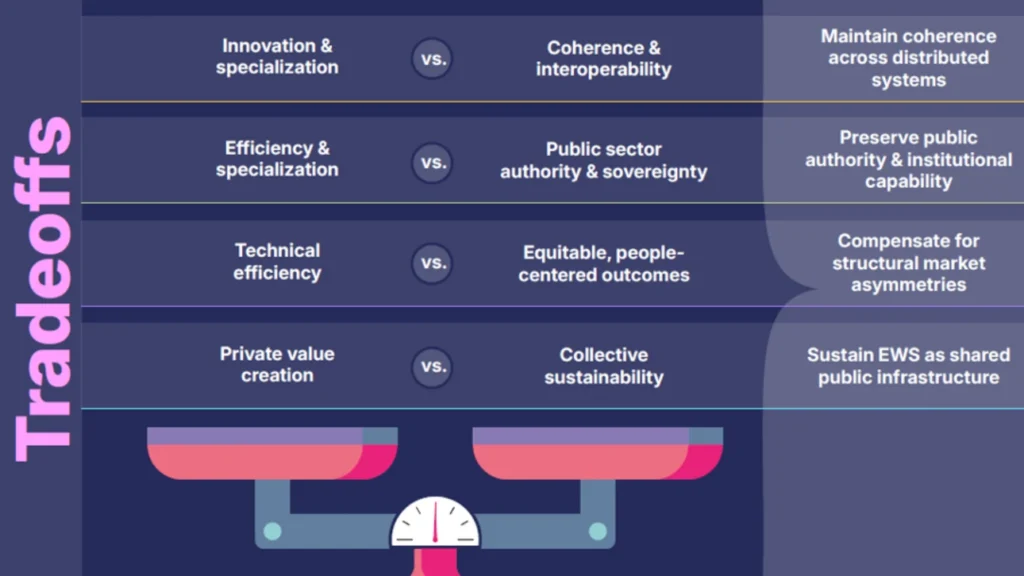
The report’s central message is simple: good governance that frames the involvement of the private sector is essential to ensure effective and fair participation. The research identifies four key trade-offs:
- Innovation and specialization versus coherence and interoperability;
- Efficiency and specialization versus public sector authority and sovereignty;
- Technical efficiency versus equitable, people-centered outcomes; and
- Private value creation versus collective sustainability.
To help practitioners navigate these tensions, the report highlights four governance principles:
- Maintaining coherence across distributed systems;
- Preserving public authority and institutional capability;
- Compensating for structural market asymmetries; and
- Sustaining early warning systems as shared public infrastructure.
From working group discussions to practical guidance
The report emerged from discussions within REAP’s Early Warning Initiatives Working Group, where partners and the co-chairs, Mirianna Budimir (Practical Action / ZCRA) and Nyree Pinder (Met Office), identified a need for stronger evidence on how private sector engagement is shaping early warning systems. To address this gap, REAP and ZCRA commissioned independent researcher Cathy Vaughan, whose analysis drew on Working Group discussions, expert interviews, literature review and a mapping of 97 firms involved in early warning system functions. Findings and recommendations were subsequently reviewed and validated by Working Group members and experts.
Why this matters now
As countries work towards the global goal of ensuring everyone is protected by early warning systems, partnerships with private sector actors are likely to become increasingly important.
REAP’s new report provides practical guidance for governments, practitioners and partners seeking to engage private sector actors while safeguarding the public-good objectives of early warning systems.
The challenge now is ensuring that these relationships are designed in ways that align private capabilities with public responsibilities and support warnings that are trusted, actionable, equitable and sustainable.
Read the full report here, and the policy brief here.
This blog was published by the Risk-informed Early Action Partnership on 26th August 2026. You can view the original here.
Comments