
In Tacana Indigenous communities in Bolivia, women are leading the way on strengthening resilience to floods and wildfires through the “Epuna ebuetsuji ecuana” (Women That Teach) initiative. Supported by Practical Action, Women That Teach provides a space for women to talk confidently about their understanding of resilience, disaster risk management, and the key roles that they play in disseminating vital information on disaster risk reduction (DRR) and Early Warning Systems (EWS) throughout their territory.
Conventional training environments have often failed to engage women as they frequently overlook roles and responsibilities, as well as cultural, social, and gender norms. For example, household duties and childcare responsibilities may keep women in the household and unable to participate, especially if timings or locations are not suitable or safe for women to access. Literacy levels, education gaps, and communication styles may also hinder engagement, as well as fear of judgement from communities. Methodologies used also typically fail to resonate with local realities. Women That Teach addresses this by dismantling the disconnect between institutional training and local wisdom, creating a tailored space that recognizes the role of women in climate resilience.
Building resilience through collective action
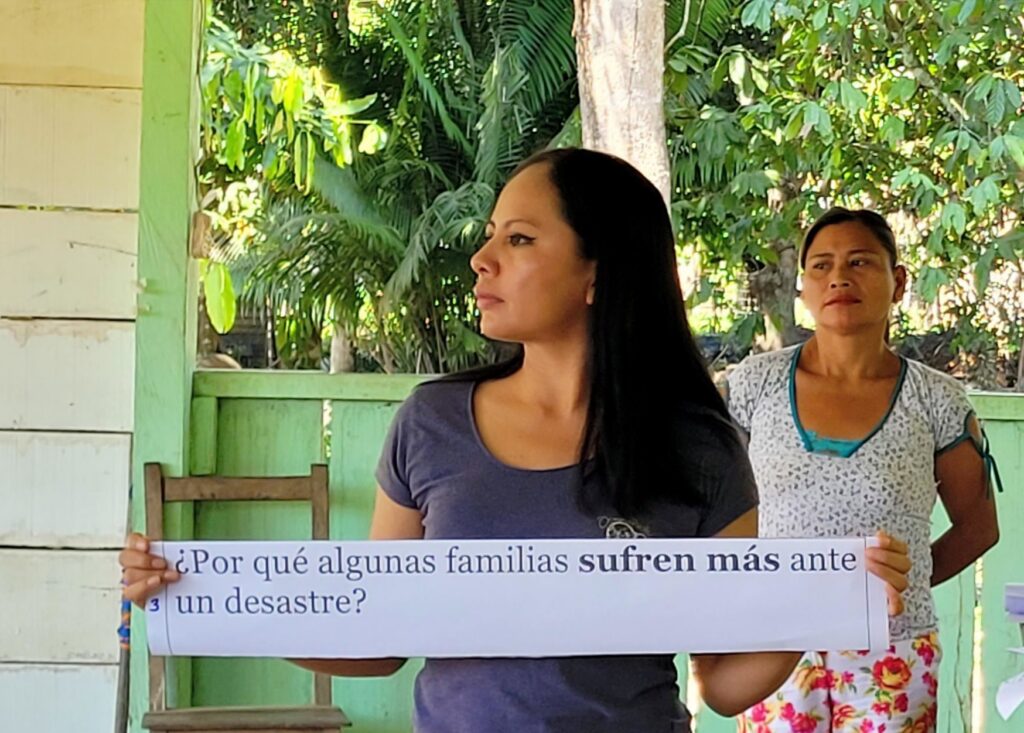
Women That Teach is based on a participatory and experiential learning approach which seeks to strengthen the confidence and capacities of women, enabling them to take leading roles in community risk management and resilience-building based on their realities, practices and knowledge.
The workshops include individual and collective reflection exercises, and creative activities and games that promote joint decision-making. This approach is fundamental as it facilitates learning in a more entertaining and participatory way whilst maintaining the essence of community gatherings and encourages women to become active participants in disaster risk and resilience education within their territories.
When you do a women’s workshop, they tell you stories [of climate hazards] in their communities based on their experiences. The same does not happen in general workshops. In this workshop, by listening to the women we have found different solutions.
Selenia Amutari Marupa, Tacana Indigenous Women Council
Replicating the initiative across Tacana
Women That Teach began with over 30 women, selected by their communities and the Tacana Indigenous Women Council (CIMTA), to learn and understand the concepts and methodology. Over two days of workshops, these women prepared to share key information and knowledge with their communities. Following the success of these sessions and a vote on which communities would benefit most, women conducted these workshops in 18 Tacana communities (approximately 80% of Tacana), reaching 615 people. Sessions primarily included women aged 17-50 and the elderly and despite other marginalizing factors such as age and local power dynamics, Women That Teach ensures that younger voices are heard.
This workshop reminds us that as women, we contribute a lot to our communities during fires and rains; we have a lot of capacity, but we believe we do not have that knowledge about early warning or what risk is. With these workshops, we are strengthening our practices and knowledge.
Roxana Terrazas, past Vice-president of the Tacana’s indigenous council (CIPTA) and responsible for the territorial risk management.
Strengthening women’s leadership
Although its implementation is recent, Women That Teach is already sharing lessons learned within Tacana Councils and its partners.
Having a good methodology to teach, learn, guide, and provide the necessary materials will make replication easier for both the local facilitator and the participants. Working on the leadership and facilitation skills of these women leaders and supporting their recognition as a benefit to the communities should be part of the entire process.
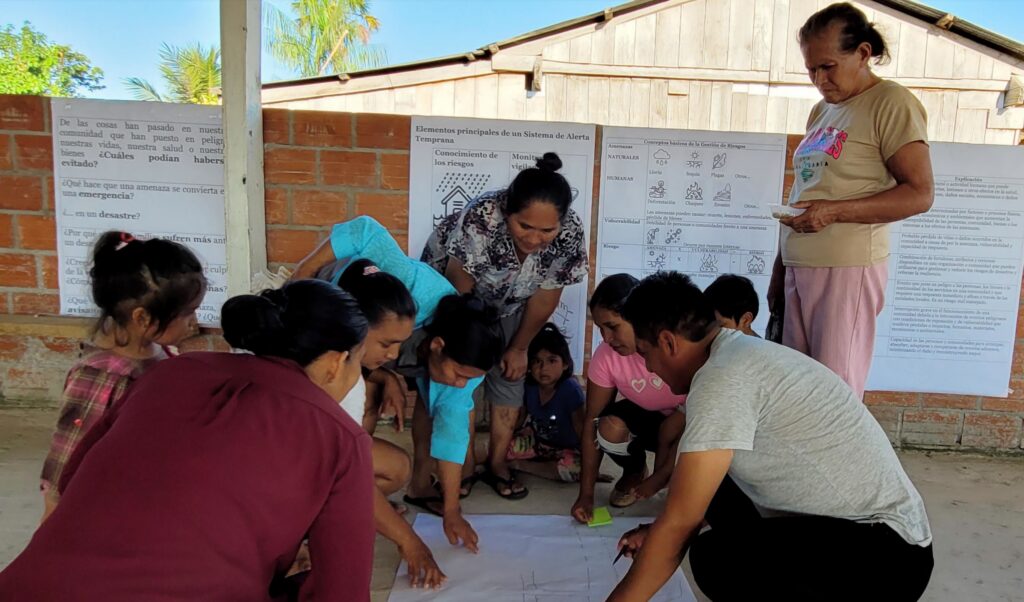
It is important to raise awareness about this type of initiative in the communities and bring concepts such as resilience, EWS and DRR, closer to the people who need it most. Participants have emphasized that the language used in the workshops is less technical and borne from the communities’ experience, therefore making it much easier to understand. Using Women Who Teach as a best practice example, CIMTA is asking all the institutions that are supporting them to strengthen local capacities and work through Tacana people.
To be effective, these learning spaces must be designed in collaboration with local actors, considering not only their needs but also their capacities and concerns. It is also beneficial to consider specific times and days for the workshops and how this will impact the participation of men and women in the community. Having separate spaces for men and women helps with participation, but it is also crucial to remember that the integration of the entire community is required to face disaster risk.
I was impressed by the depth of [the participants’] commitment and how their ancestral knowledge, combined with technical knowledge, can be used to prevent disasters. For example, when hunting ants invade the community, or when the ambaibo leaf turns over, communities know that heavy rain, and potential flooding, are on the way. They then begin to store seeds in trojes (traditional granaries) and reinforce their guarachas (high wooden shelves inside their homes) to keep their documents and food high up and even shelter their animals if necessary. Through their participation, the women were able to transform their first hand experiences into useful knowledge for risk management.
Patricia Loayza, facilitator of Practical Action
By strengthening women’s leadership and including women from diverse backgrounds into the workshops, the Tacana people are reaffirming themselves as united and resilient, increasingly capable of managing their territory when faced with the intensifying impacts of climate hazards.
See the Missing Voices Approach Manual for more details on strengthening climate resilience though the involvement of women and other marginalized groups
Women That Teach was led by CIMTA in collaboration with CIPTA, Practical Action, and the Lloyds Register Foundation as part of the Climate Resilience Program.
Comments