
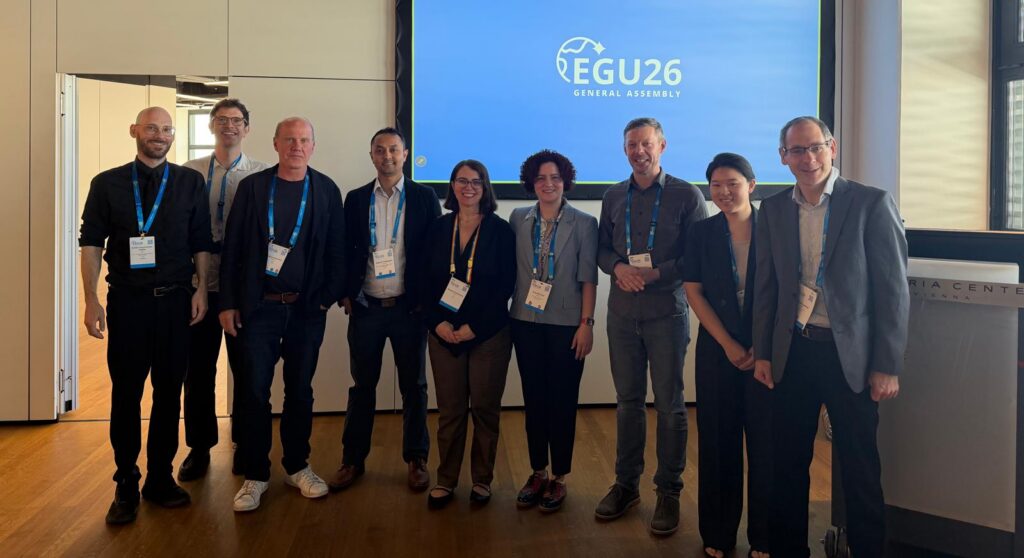
More than 20,000 people attended this year’s General Assembly of the European Geoscience Union (EGU) in Vienna. Alliance colleagues from Concern Worldwide, IIASA, LSE, Practical Action and the Z Zurich Foundation were in attendance, sharing their knowledge on topics from multi-hazard Early Warning Systems to improving inclusivity in nature-based adaptation initiatives. Here are their key takeaways from EGU 2026.
To tackle poverty, build resilience to all climate hazards
An early session made the point that while investments in Climate Change Adaptation (CCA) are usually talked about in terms of their economic benefits, efforts to reduce poverty tend to focus on improvements to education and employment.
Increasing resilience to floods and other climate hazards can be extraordinarily effective at reducing levels of poverty and inequality. It’s not necessarily a new idea – we’ve long advocated for the ‘triple-dividend’ approach, which considers economic, ecological and social benefits of resilience alongside avoided losses – but it needs to be effectively communicated to policymakers. Indeed, a few sessions at EGU explored how the ways in which we frame climate risks will be crucial to translating physical climate science into social meaning, to better convey urgency and support decision-making.
In addition, we need to consider resilience to all climate hazards. Focusing on individual hazards in isolation can lead to fragmented response efforts, inefficient use of resources, and missed opportunities to address interconnected risks. Multi-hazard approaches (including multi-hazard EWS) came up frequently at this year’s EGU; as well as sharing our learnings from Nepal, Peru, and the Philippines, Alliance colleagues participated in dialogues with EGU participants to identify gaps, opportunities, and ways forward together to improve multi-hazard approaches to climate resilience.
Mental health impacts must not be overlooked
A recurring theme at EGU 2026 was the link between climate hazards and human health impacts, including mental health. The physical impact of disasters triggered by climate hazards is, of course, well-documented, but it’s far from the full picture. One EGU session touched on the phenomenon of solastalgia, a sense of homesickness despite not having left home. It is brought on by negatively-perceived changes to one’s environment – exacerbated, of course, by the severe disruption brought about by climate hazards.
Another session proposed taking a quantitative-qualitative approach to estimate mental health impacts, rather than focusing on narratives. For example, through appropriate combinations of environmental and health data – such as linking the results of health surveys with satellite-based land surface temperature measurements – it is possible to detect heat-related mental health effects at the regional scale.
These findings reinforce the importance of considering wellbeing and mental health outcomes when evaluating resilience and climate adaptation interventions, particularly in urban contexts. On the whole, mental health impacts are less visible than economic loss and damage, which often means that the true impact of a disaster on a community isn’t adequately recorded – but by taking a scientific approach, that can be addressed.
Technology is a double-edged sword
As in many other parts of life, technology presents both opportunities and challenges for climate adaptation. This was made apparent in two EGU sessions, the first of which looked at how ‘citizen science’ and participatory technologies can strengthen resilience. An inspiring example from Kivu in DR Congo illustrated how citizen networks help collect real-time information on floods and other hazards using smartphone-based reporting tools connected to an online platform. Not only is this delivering data in areas with limited institutional capacity and difficulties with access, but it’s also catalyzing inclusive, locally grounded adaptation and policymaking in a fragile context.

Elsewhere, a panel discussion highlighted how social media can spread scientific misinformation and conspiracy theories, including in relation to climate hazard events. When comparing countries that are otherwise similar in socioeconomic terms, the fatality rates are higher in the ones where misinformation related to hazards is more prevalent. The scientific community can help to counter this by making its modelling open-source and fully transparent – but many research institutions are not yet as open as they should be.
Expect the unexpected
As ever, the EGU General Assembly proved fertile ground for advancing resilience to climate hazards through science-based approaches. As impressive and informative as the collated knowledge and evidence was, however, it’s clear that much more needs to be done – not least in improving datasets to better reveal how age, location, gender and other variables affect resilience. One EGU session suggested that, in part due to mobility patterns and the demands of the labour market, heat-related risks are actually higher for younger age groups than older adults, in contradiction to existing assumptions.
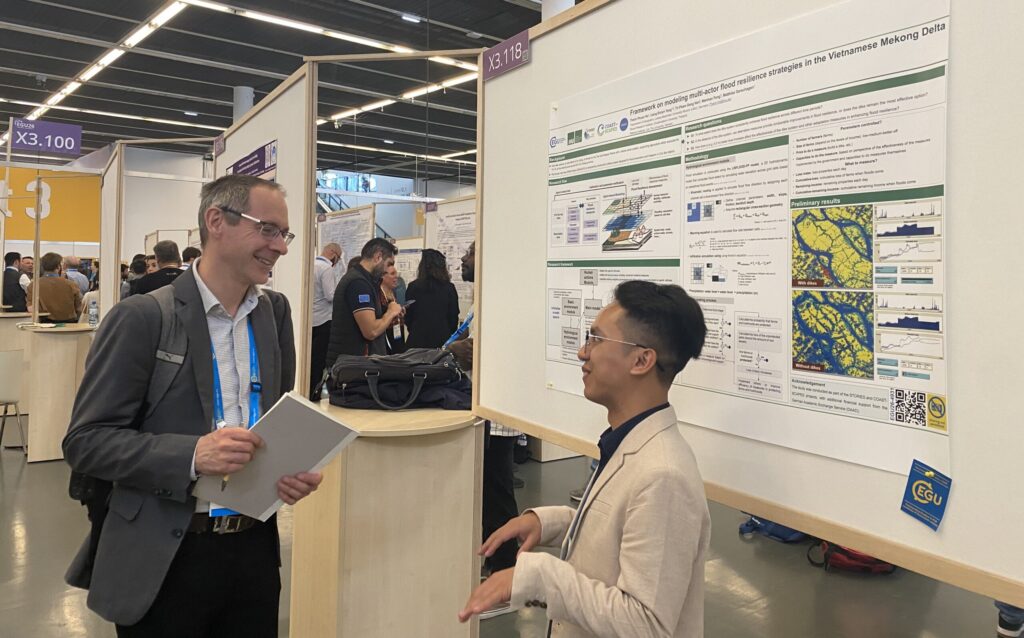
While great progress has been made in modelling hazards, large gaps still exist in the modelling of exposure and vulnerability. We must also be wary of basing approaches to risk management only on what has come before; as hazards become ever more extreme and complex, we continue to be surprised by their intensity and destruction potential. Instead, we must be ‘ready for anything’, up to and including High-Impact, Low-Probability (“HILP”) events that are often difficult to predict but have massive impacts.
That will require drastic shifts in policy, and the cost-related barriers are significant – but getting this right will ensure the safety and prosperity of countless communities all around the world.
Visit our EGU26 event page for more on the Alliance’s participation at EGU.
Comments